Part 2: The Ancient Roots of Consciousness
Meditation, Mysticism, & Healing
Part 2 takes us backward. This section is more of a history lesson to show the foundation of meditation. Before meditation became an app, a stress tool, a corporate wellness program, or a science-backed mental health practice, it was part of humanity’s history. Almost every ancient society used meditation as a part of their health regiment.
People also wanted to know where life came from. They wanted to understand dreams, death, illness, love, nature, the stars, the gods, and the strange power of thought. They wanted to know why prayer seemed to work, why certain words felt powerful, why rhythm changed the body, why silence opened visions, and why some people seemed to heal, or see beyond the veil, or sense things others couldn't.

The Deep History of Meditation
The practice of meditation is older than the actual word 'meditation.'
Before anyone wrote meditation instructions on paper, people were already entering altered states through silence, chanting, drumming, fasting, prayer, dance, isolation, their breath, and sacred plants. No one knows the very first person who meditated but we have a sneaky suspicion that the practice is prehistoric.
The earliest written references to meditation can be traced to ancient India, especially the Vedic and Upanishadic world. The older Vedic tradition used sounds and rituals like fire offerings. Yep. I know it sounds a bit weird but later Upanishadic teachings turned society inward and asked deep questions about the self, ultimate reality, and consciousness. Old Hindu texts like the Upanishads and the Bhagavad Gita discuss meditation as a path of liberation from suffering.
They weren't really asking, “How do I relax?” It was way bigger. More like, “What is the relationship between my inner consciousness and a larger reality?”
How Far Back Can We Go?
Some popular meditation histories claim that wall art from the Indian subcontinent, are dated thousands because they show people seated in meditative postures. Bhimbetka petroglyphs in central India date back at least 290,000 years! No one really knows but I think that meditation is as old as time itself.
The Rig Veda was written over 3,000 years ago and is treated as one of the oldest pieces of Sanskrit sacred literature. It is not a meditation manual but it's full of songs, ritual language, and talks about a relationship with divine powers. Later. the Upanishads moved the search inward. Instead of only asking how to perform ritual, they ask what the Self is, what consciousness is, and how the individual relates to ultimate reality.
This shift is one of the great turning points in human spiritual history. The temple begins moving inside the person, instead of being just a building.
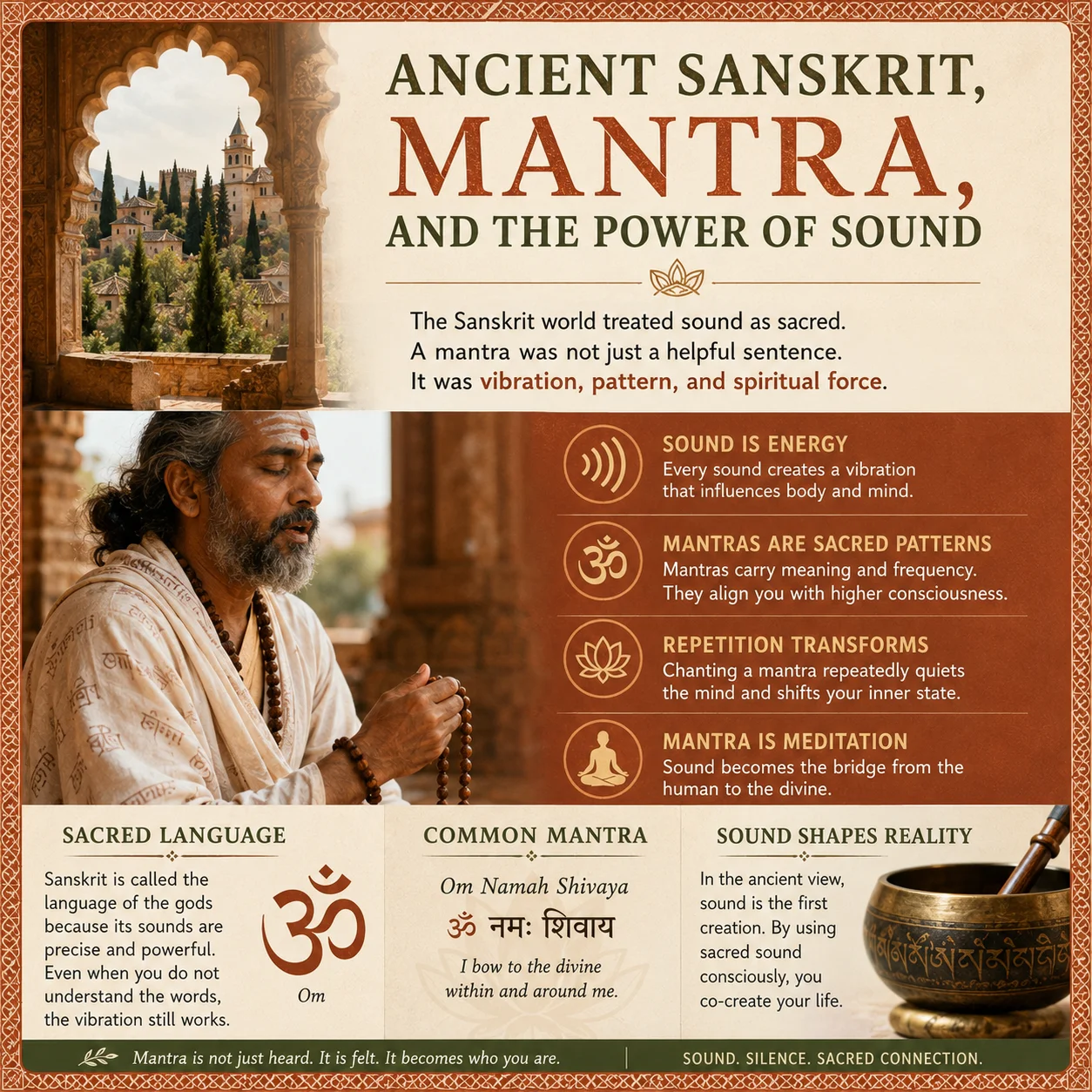
Ancient Sanskrit, Mantra, and Repetition
The Sanskrit world treated sound as something sacred. A mantra was not just a helpful sentence. It was vibration, pattern, and spiritual force.
This is one reason modern manifestation practices feel so old... It's because they kinda are. When people repeat affirmations, declarations, “I am” statements, prayers, or scripting phrases, they are doing something very close to what people have been doing for thousands of years. They are using repeated sound to alter the mind, train their identity, and change their emotional state.
In today's scientific world, we know that repetition affects the subconscious mind. In fact, repetition is the primary mechanism for programming the subconscious mind, as it triggers long-term potentiation, a neurological process that strengthens neural pathways and embeds thoughts, beliefs, or behaviors into the unconscious. In spiritual language, we might say repetition charges the field. In religious language, we might say sacred speech aligns the person with divine order. The wording changes but the pattern is the same.
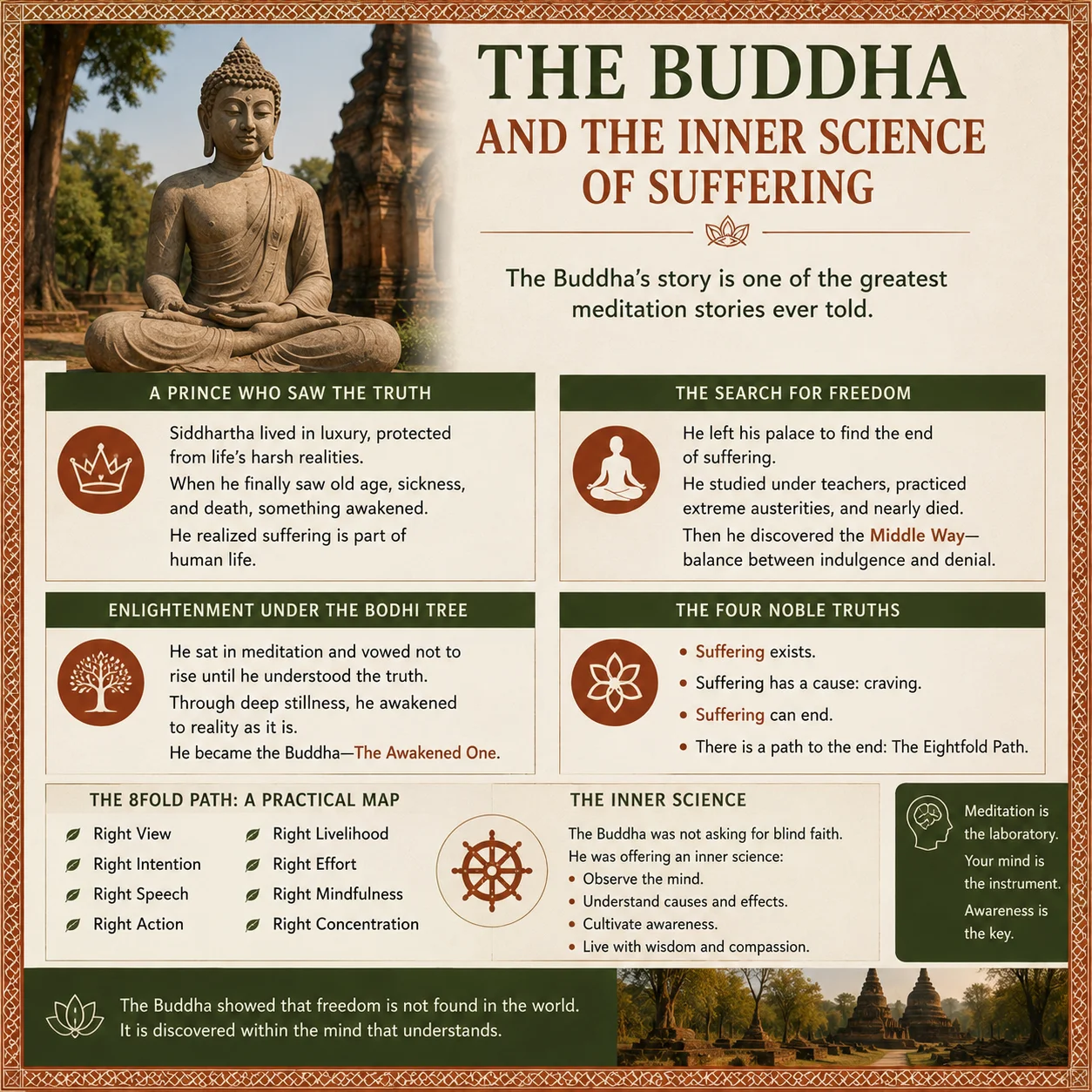
The Buddha and the Inner Science of Suffering
Siddhartha Gautama was said to have sat beneath the Bodhi tree with a fierce inner decision. He would not get up until he was awakened with enlightenment. He stated that even if his flesh and blood dried up, he would not move until he found the ultimate truth.
This story matters because it shows meditation as more than calm breathing. It is a confrontation with the illusion of fear. It shows that you have to be determined to change your mind in ultimate adversity.
The Buddha’s path asks the practitioner to look directly at craving, fear, suffering, impermanence, and the way the mind builds reality. Buddhist meditation became a disciplined path of concentration, insight, compassion, and freedom. Britannica describes Buddhist meditation as mental concentration leading through stages toward spiritual freedom or nirvana.
Buddhism gives a powerful warning and a powerful gift. The warning is that desire can become suffering. The gift is that awareness can free us from unconscious creation.
A person may say, “I want abundance,” but underneath they are meditating all day on lack. They may say, “I want love,” but underneath they are rehearsing rejection. They may say, “I want healing,” but underneath they are living in fear of the body.
Buddhist-style awareness helps you see the hidden meditation already happening.
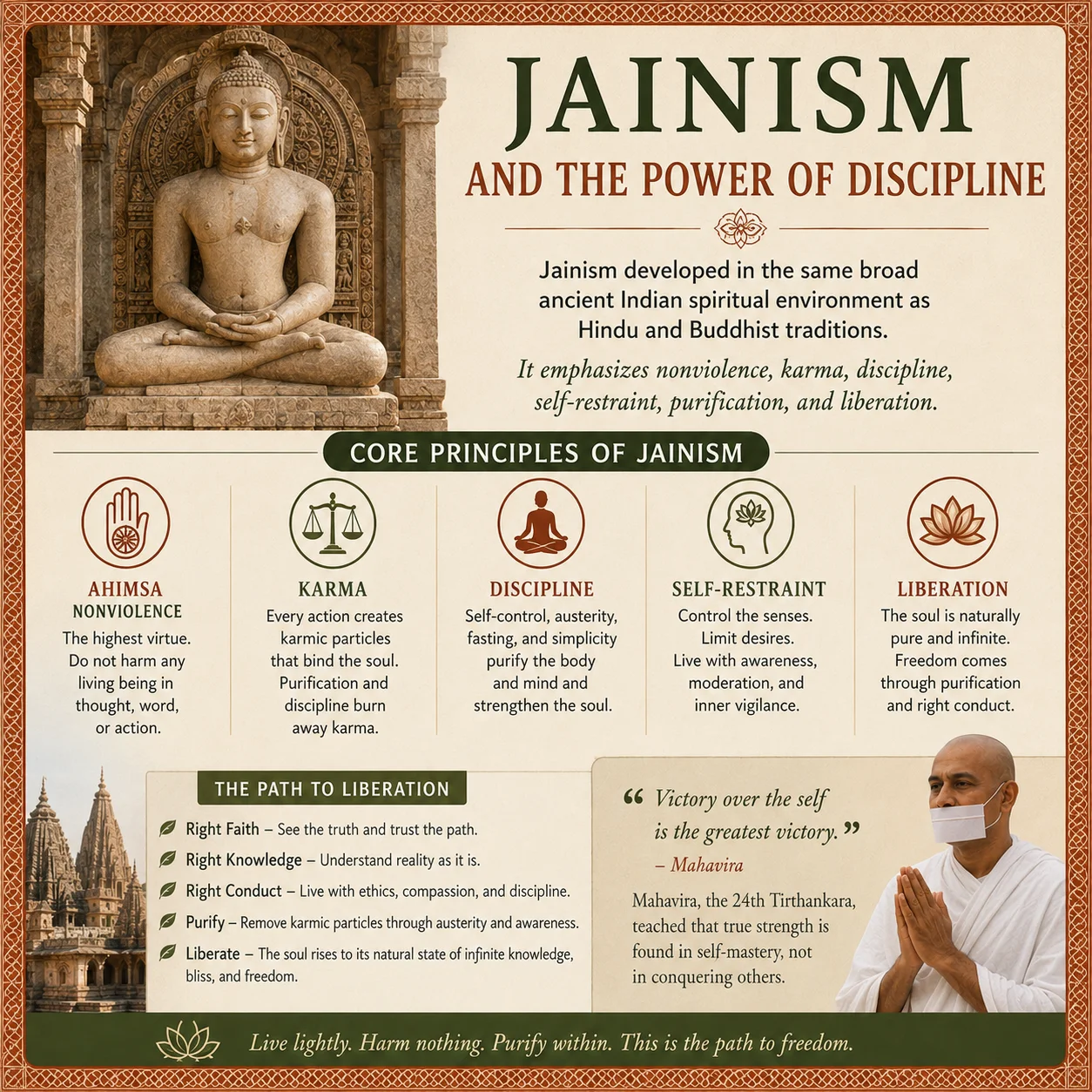
Jainism and the Power of Discipline
Jainism developed in the same broad ancient Indian spiritual environment as Hindu and Buddhist traditions. It emphasizes nonviolence, karma, discipline, self-restraint, purification, and liberation. It speaks about how energy follows conduct.
It's not enough to visualize a beautiful life while acting from harm, carelessness, or coconscious desire. Jain practice asks the seeker to refine their whole life. Thoughts matter. Words matter. Actions matter. Attachments matter.
This creates a bridge between manifestation and ethics. The student is not only asking, “What do I want?” The deeper question is, “Who am I becoming as I call this want to me?”
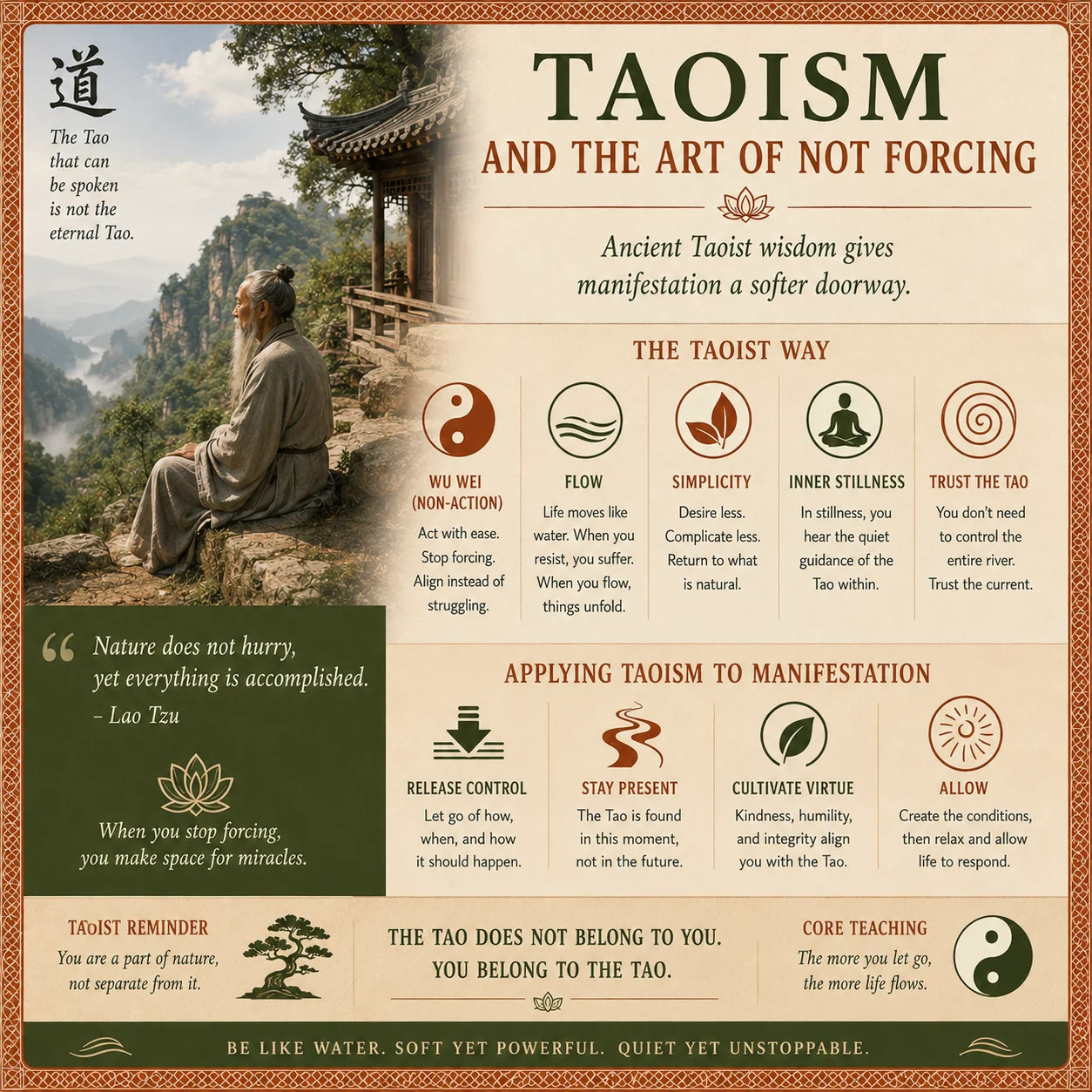
Taoism and the Art of Not Forcing
Taoism teaches the Tao, the mysterious way of nature. It values simplicity, flow, stillness, humility, and harmony. Where some manifestation teachings become intense and forceful, Taoism reminds the student that life also creates through ease.
The Taoist lesson is not “do nothing.” It is “stop fighting the current of life.”
In modern society, many people try to manifest from a state of panic. They visualize from desperation. They affirm from fear. They pray while secretly believing they are abandoned. Taoism would say the energy is too tight.
The Taoist bridge to manifestation is to align first, then move. When the student is aligned, their action feels cleaner. The next step appears more naturally. The body softens. The field opens. And the desire is no longer strangled by fear.
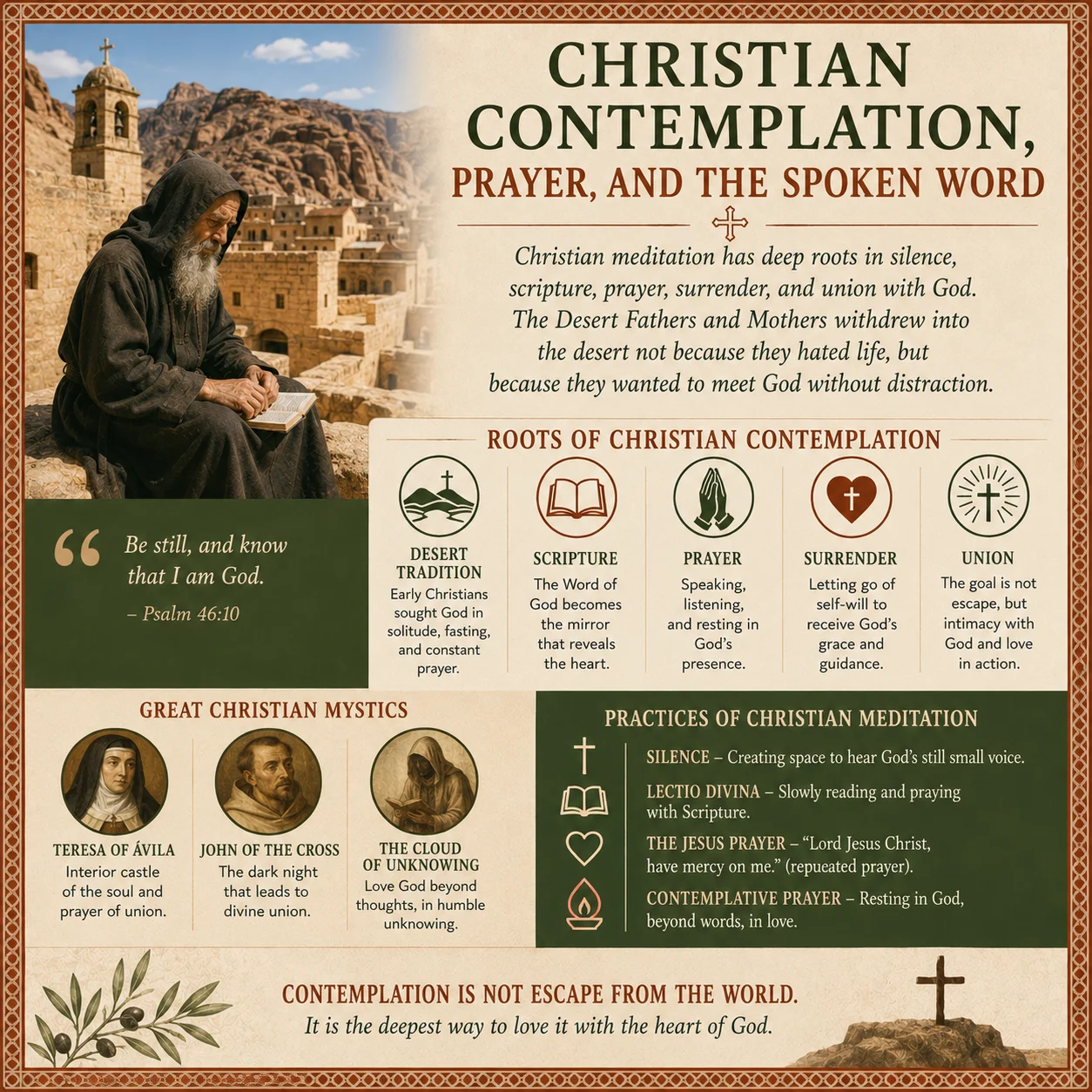
Christian Contemplation, Prayer, and the Spoken Word
Christian meditation has deep roots in silence, scripture, prayer, surrender, and union with God. The people walked through the desert because they wanted to meet God without distraction. They left behind noise, comfort, and daily pressure so they could listen more deeply.
Later, Jesus taught principles that sounds very close to what the Law of Attraction is today. He taught to ask with faith, believe you have it before you see the proof, and then receive it.
Christianity adds some of the strongest historical language around faith, belief, and speaking creation into existence.
Christian practices also teach surrender. This is where manifestation becomes more mature. The student may desire, imagine, and pray, but then releases the need to control every detail.
This is the difference between physical manifestation and faith-filled manifestation. Physical manifestation says, “I must force this to happen.” Faith-filled manifestation says, “I align, I ask, I believe, I listen, I act, and I release the how.”
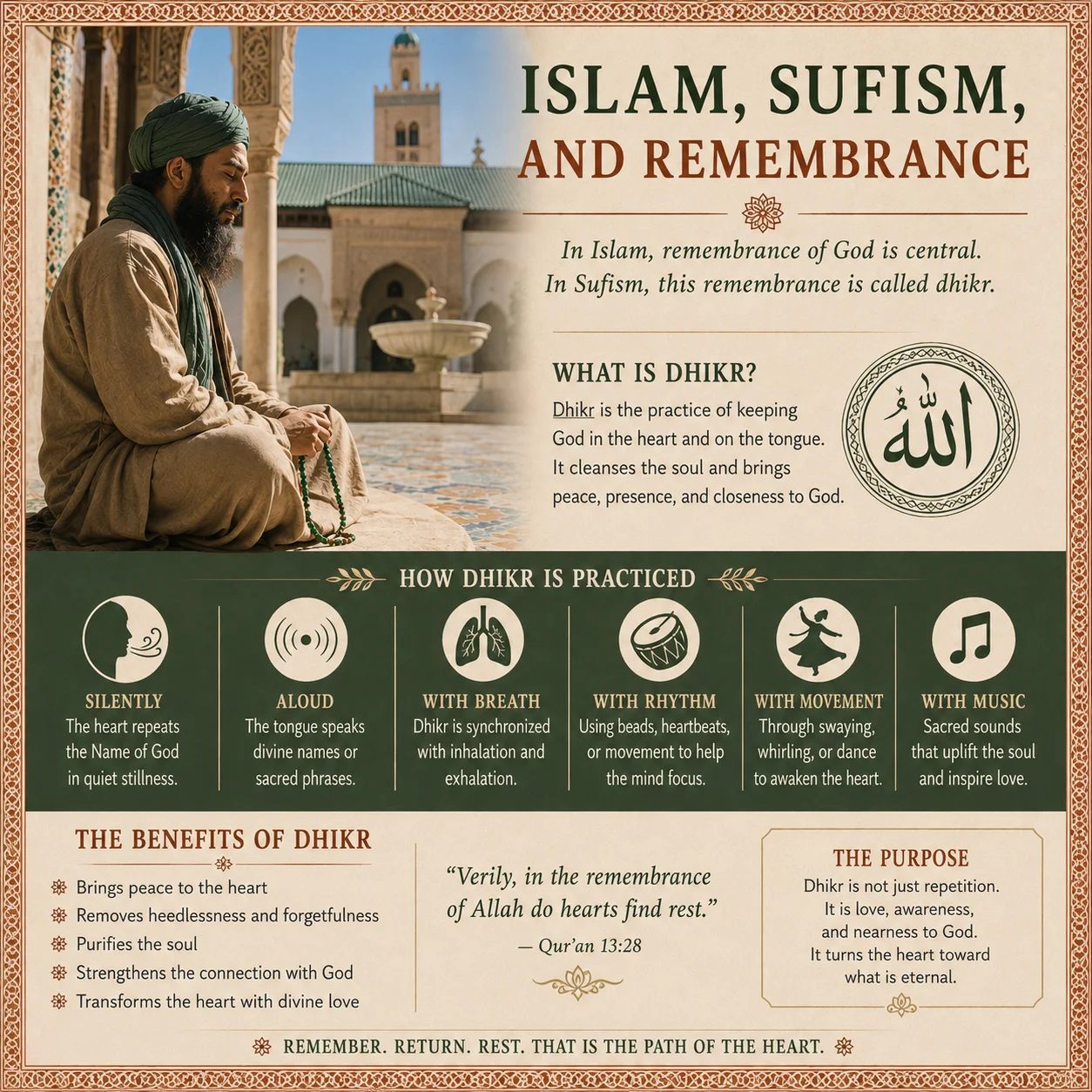
Islam, Sufism, and Remembrance
In Islam, remembrance of God is central. In Sufism, this remembrance is called dhikr. Dhikr often involves repeating divine names or sacred phrases, sometimes silently, sometimes aloud, sometimes with breath, rhythm, music, or movement.
Instead of letting the mind repeat fear, the practitioner repeats divine presence. Instead of letting the nervous system worship the problem, the heart returns to God.
The Qur’an also contains a verse often used in transformation teachings that says, "God does not change the condition of a people until they change what is within themselves."
Judaism, Kabbalah, and Conversation With God
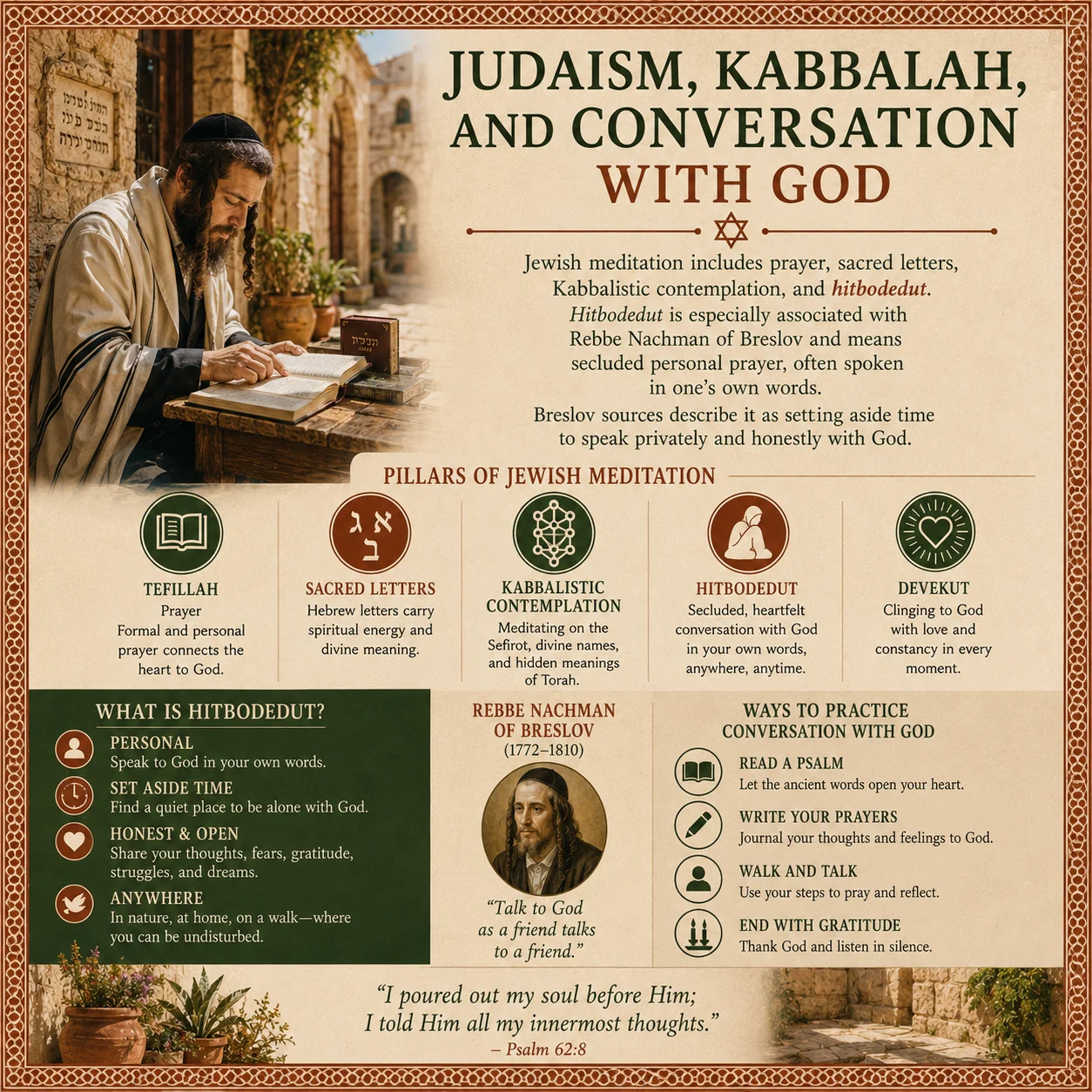
Jewish meditation includes prayer, sacred letters, Kabbalistic contemplation, and personal prayer, often spoken in one’s own words.
A student can sit alone and speak to God, Source, the universe, or the higher self without pretending. This kind of practice clears the inner channel. It lets the hidden fear come up, lets the desire become honest, and lets gratitude become real.
Kabbalah also adds the mystical idea that letters, numbers, names, and the spoken word carry creative power. This connects naturally with affirmations, scripting, sacred geometry, and the idea that reality is built through vibration and pattern.
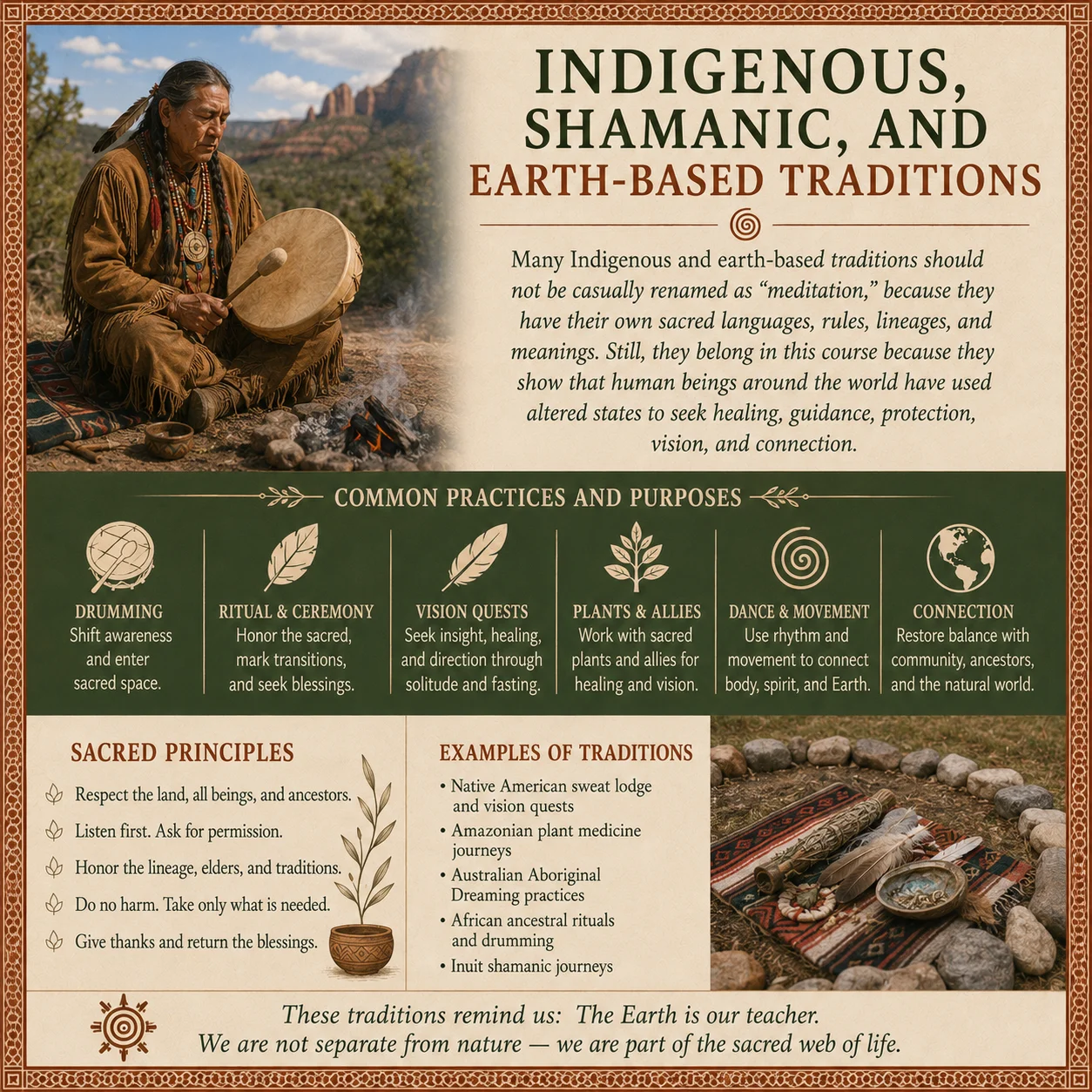
Indigenous, Shamanic, and Earth-Based Traditions
Many Indigenous and earth-based traditions should not be casually renamed as “meditation,” because they have their own sacred languages, rules, and meanings. Still, they show that human beings around the world have used altered states to seek healing, guidance, protection, and connection.
These traditions may include drumming, chanting, dance, sweat lodge ceremony, fasting, dream work, ancestor reverence, plant medicine, sacred storytelling, and vision quests. The common thread is not that all traditions are the same. They arn't... Far from it. The common thread is that human beings have always believed consciousness can cross a doorway, no matter what religion you are or aren't a part of.
In modern manifestation language, that doorway is often called 'The Quantum Field.' In religion, it may be called God. In shamanic language, it may be called Great Spirit. In psychology, it may be called an altered state. In neuroscience, it may be studied through brain waves, perception, emotion, and meaning. It's all the same.
Witches, Herbalists, Fortune Tellers, and the Fear of Hidden Knowledge
No honest history of meditation, manifestation, and healing can ignore the people who were feared for working with the unseen. The Christian religion has hunted and executed accused witches, fortune-tellers, and people said to consort with spirits far more than any other religion in history.
The Bible commands the execution of mediums and spiritualists, stating that mediums must be put to death.
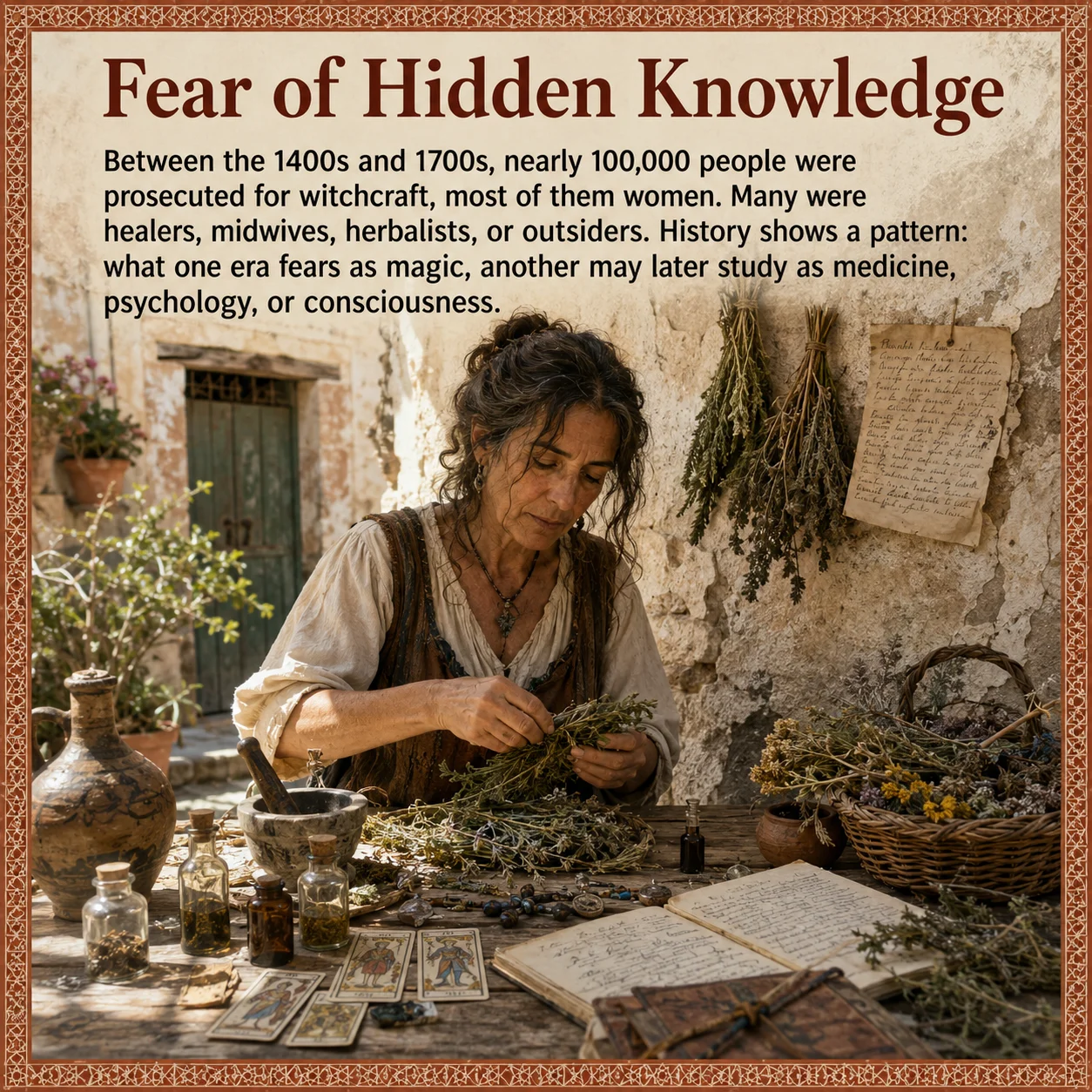
In Europe and the Americas, major witch hunts occurred between the 15th and 18th centuries. Historians estimate nearly 100,000 people were prosecuted for witchcraft, with 40,000 to 60,000 executed, and the majority were women.
Some accused witches were probably just regular people caught in hysteria, politics, misogyny, poverty, or religious fear. Some were midwives, healers, herbalists, outsiders, or women who didn't fit expected roles. Some used plants to heal and the hallucinations were thought of as something from the spirit world. Some used charms or incantations. Some may have practiced folk magic. Some were simply blamed for misfortune.
Even in modern history, Saudi Arabia created an Anti-Witchcraft Unit to combat sorcery, traditional healing, and fortunetelling. Executions for "sorcery" continue today. In 2011, thousands of women in India were executed in a brutal witch hunt.
This history reveals a pattern that humans have repeated over and over and over. People (usually men) often fear others who aren't like themselves. We often fear what we don't understand and what we can't control. This thinking has caused so may early and unneeded deaths throughout history.
However, this is all backwards thinking. In fact...
Herbs were once folk knowledge. Now many plant compounds are studied pharmacologically. Meditation was once considered strange by many Westerners. Now hospitals and universities study it. Breathwork once belonged mostly to spiritual practice. Now researchers study breathing and nervous system regulation. Placebo was once dismissed as “nothing.” Now major medical schools study expectation, meaning, ritual, and the therapeutic relationship.
What looks like magic in one era may become medicine, psychology, or consciousness research in another.
Sign in to access the platform
Turning Fear into Love
Do you fear others that aren't like you? If so, how could you think differently to turn that fear into love?
0/300
Fortune Tellers, Divination, and Symbolic Knowing
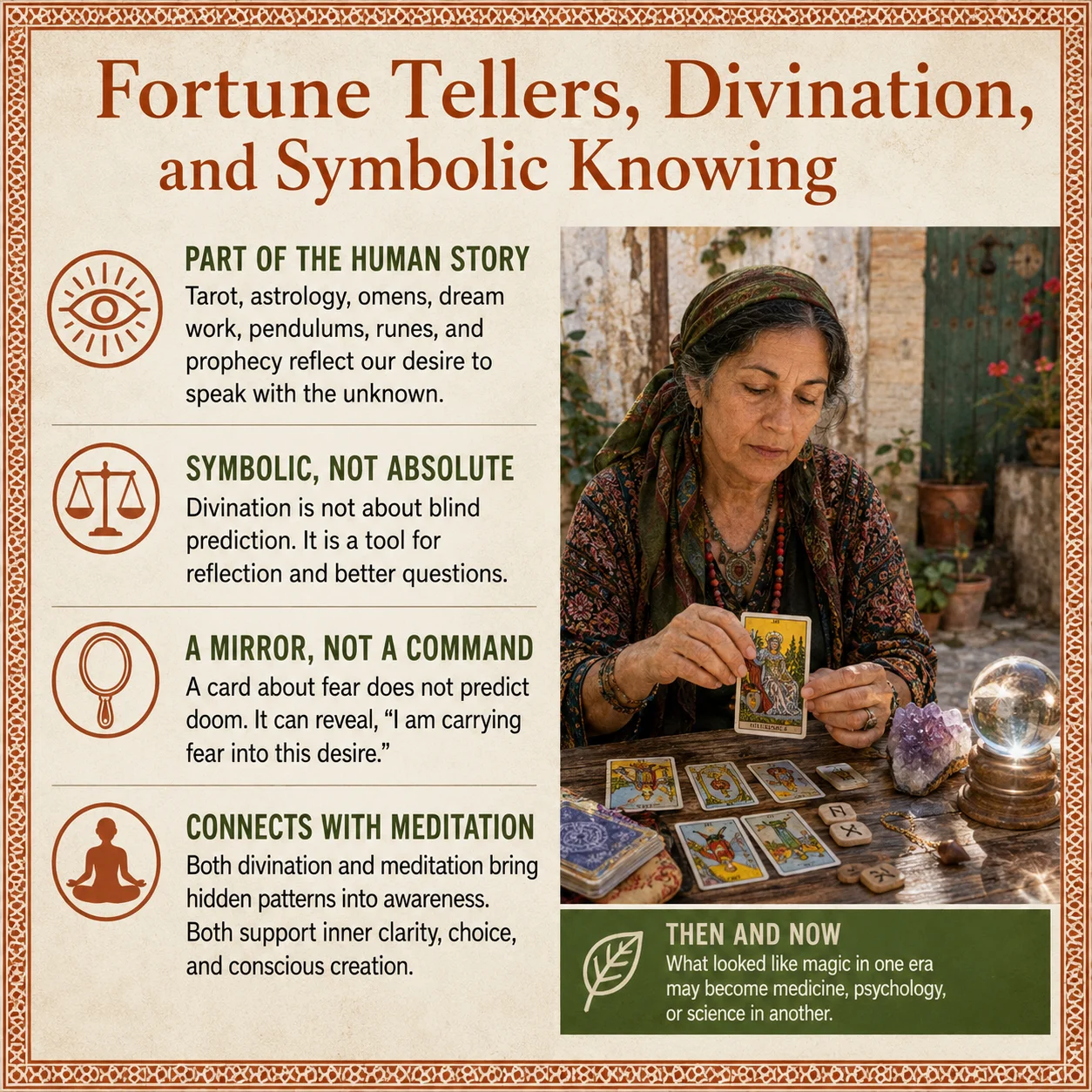
Fortune telling plays a role in these studies because because divination reveals the human desire to speak with the unknown. Of course, every prediction shouldn't be accepted blindly but we don't yet know what we don't know and some people have different abilities than others.
A note from Ryan about someone else telling your fortune, before we move on.
When I was about 20, I went to a fortune teller. She told me I would meet a woman with black hair and dark skin, and that this woman would become my wife. She described other things too, details that match my wife's personality almost exactly today. Tarot, astrology, omens, dream interpretation, pendulums, runes, and prophecy all ask a similar question: “Is there information beyond ordinary thinking?”
Now, I don't believe anyone can predict your future. Here is why. I believe that everything which could ever happen, everything happening right now, and everything that has the potential to happen later, all exist together in the realm of possibility. It is all already there.
What I do believe is that some people can see across the veil and show you a potential future. And if you align yourself with the frequency of that future, the way I did, then that future can play out. I don't think the fortune teller saw my one and only fate. I think she saw one possible path, and I walked toward it. Does that make sense?
Divination connects with meditation because meditation also reveals hidden universal material. Both practices can bring unconscious patterns into your awareness.
Sacred Plants, Mushrooms, DMT, and Toad Venom
Sacred plant and substance traditions are not the main focus of this course, but they do belong in the larger story of altered consciousness.
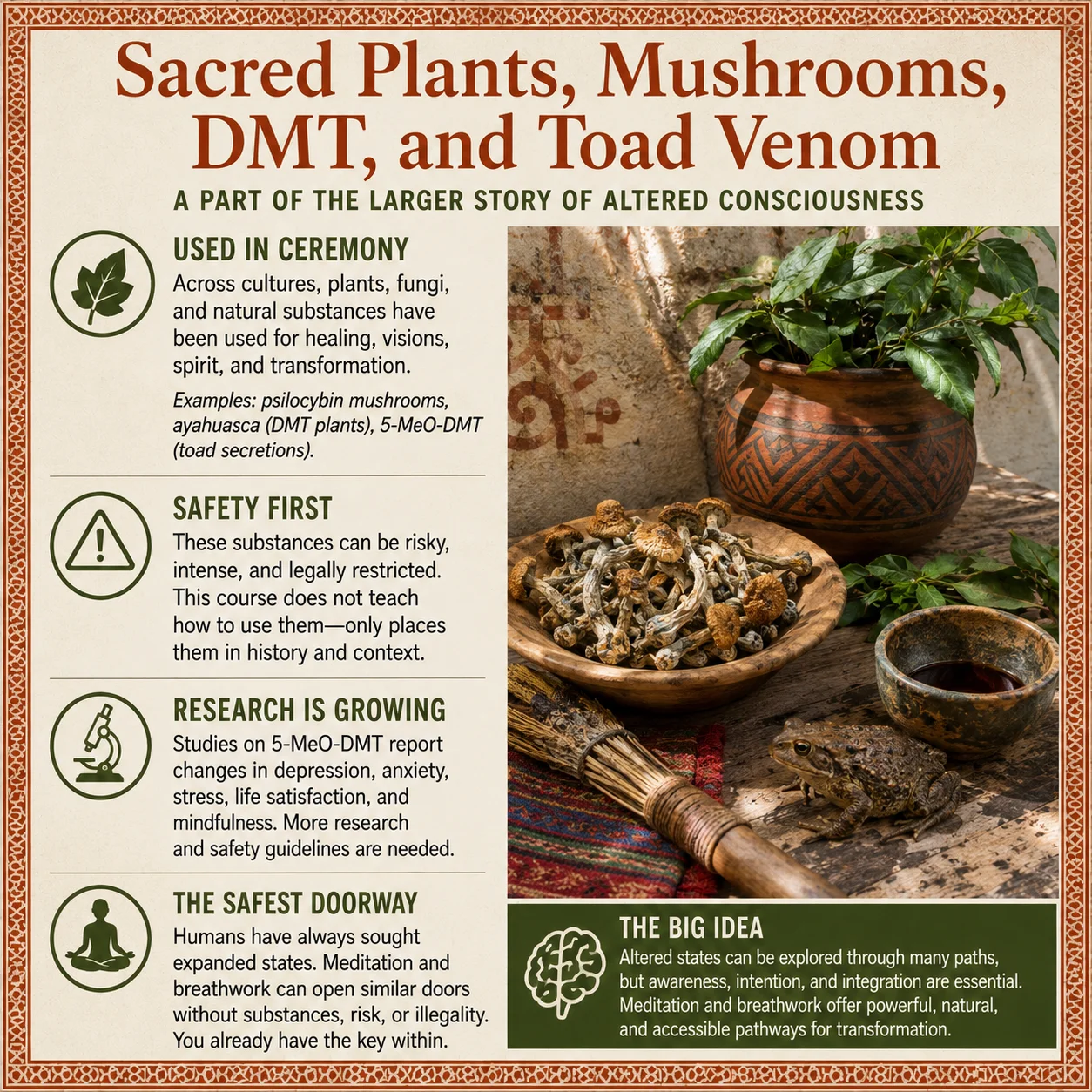
Across cultures, people have used plants, fungi, and natural substances in ceremony to seek healing, visions, death-rebirth experiences, communion with spirit, and personal transformation. Modern examples include psilocybin mushrooms, ayahuasca traditions involving DMT-containing plants, and 5-MeO-DMT, which is associated with certain toad secretions. Even high doses of cannabis have helped in spiritual awakenings.
This topic needs a clear safety boundary. These substances can be medically risky, psychologically intense, and legally restricted depending on your location. Be extremely careful if you go this route.
Peer-reviewed research has studied psilocybin and DMT, including reports of changes in depression, anxiety, stress, life satisfaction, and mindfulness-related measures. Often, when consuming these substances, you go through a life transformation that can last weeks, years, and even change your personality for the rest of your life.
Humans have always sought ways to loosen the grip of ordinary perception. Even though these substances can alter your reality, did you know that meditation is one of the safest and most accessible doorways to do the same thing? It does not require ingesting anything, breaking the law, or overwhelming the nervous system.
...and guess what? There are methods to induce psychedelic states through breathwork so the outside substances may not even be needed at all.
The Bridge: Ancient Magic and Modern Science
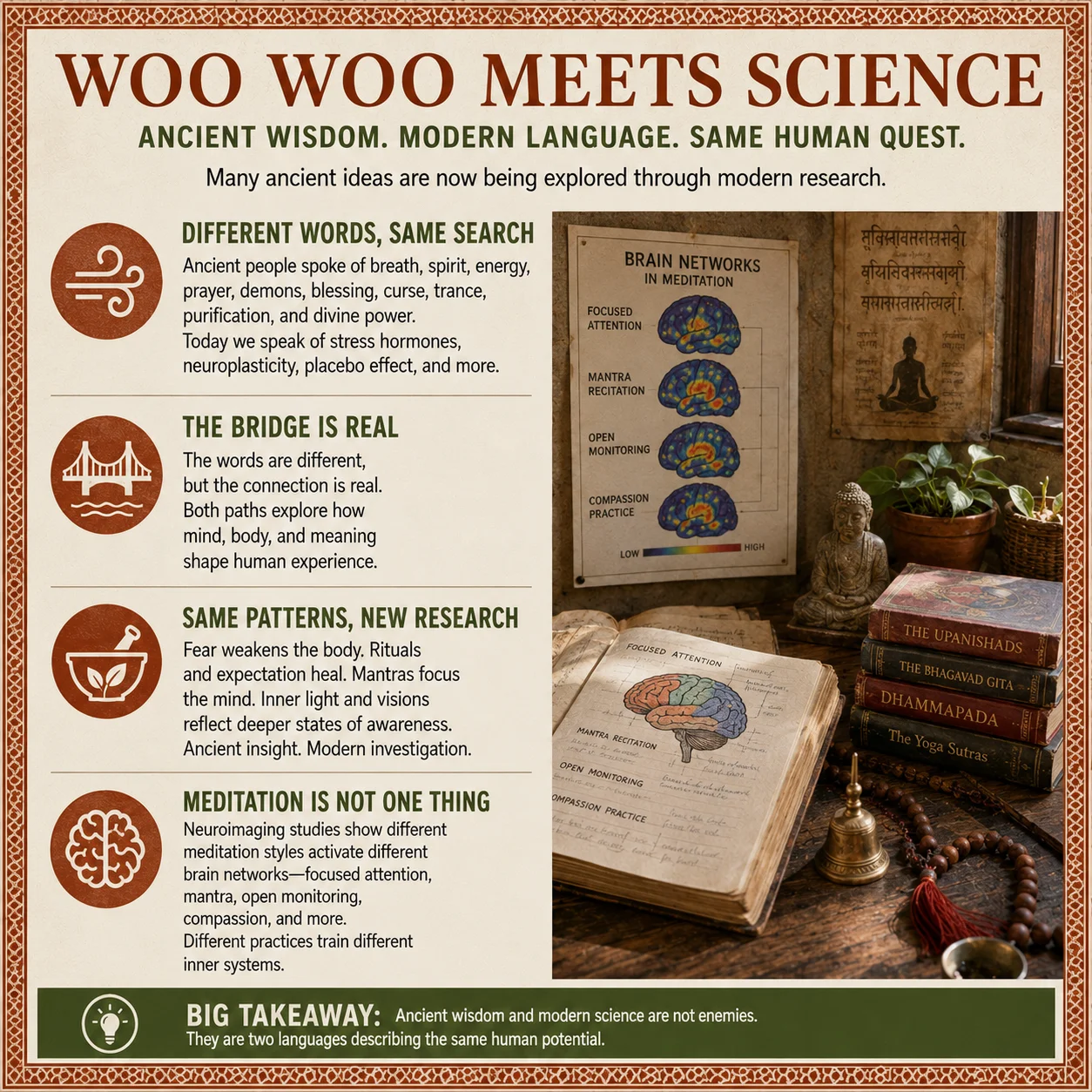
This course uses the phrase “Woo Woo Magic” because many ancient ideas are now being explored through modern science. When we see things once deemed religious and also see science confirming it, some people don't really want to change their beliefs so we play into their own wording.
Ancient people spoke of breath, spirit, energy, prayer, demons, blessing, curse, trance, purification, and divine power but modern researchers may speak of stress hormones, autonomic regulation, neuroplasticity, placebo effect, psychoneuroimmunology, expectancy, epigenetics, trauma memory, and brain-wave states.
The words are different, but the bridge is real.
For example, ancient people knew that fear made the body weak. Today, stress research studies how chronic stress affects health. Ancient healers used ritual and expectation. Today, placebo researchers study how meaning and belief influence symptoms. Ancient traditions used mantra. Today, brain research studies attention, repetition, sound, and meditation. Ancient mystics spoke of inner light and vision. Today, consciousness researchers study altered states, imagery, and non-ordinary perception.
A review and meta-analysis of meditation neuroimaging studies found that different meditation styles show different patterns of brain activation and deactivation, including focused attention, mantra recitation, open monitoring, and compassion practices.
That is a major point for this course. Meditation is not one vague thing. Different inner practices appear to train different inner systems. The word of the ancients are being proven by the science of today.
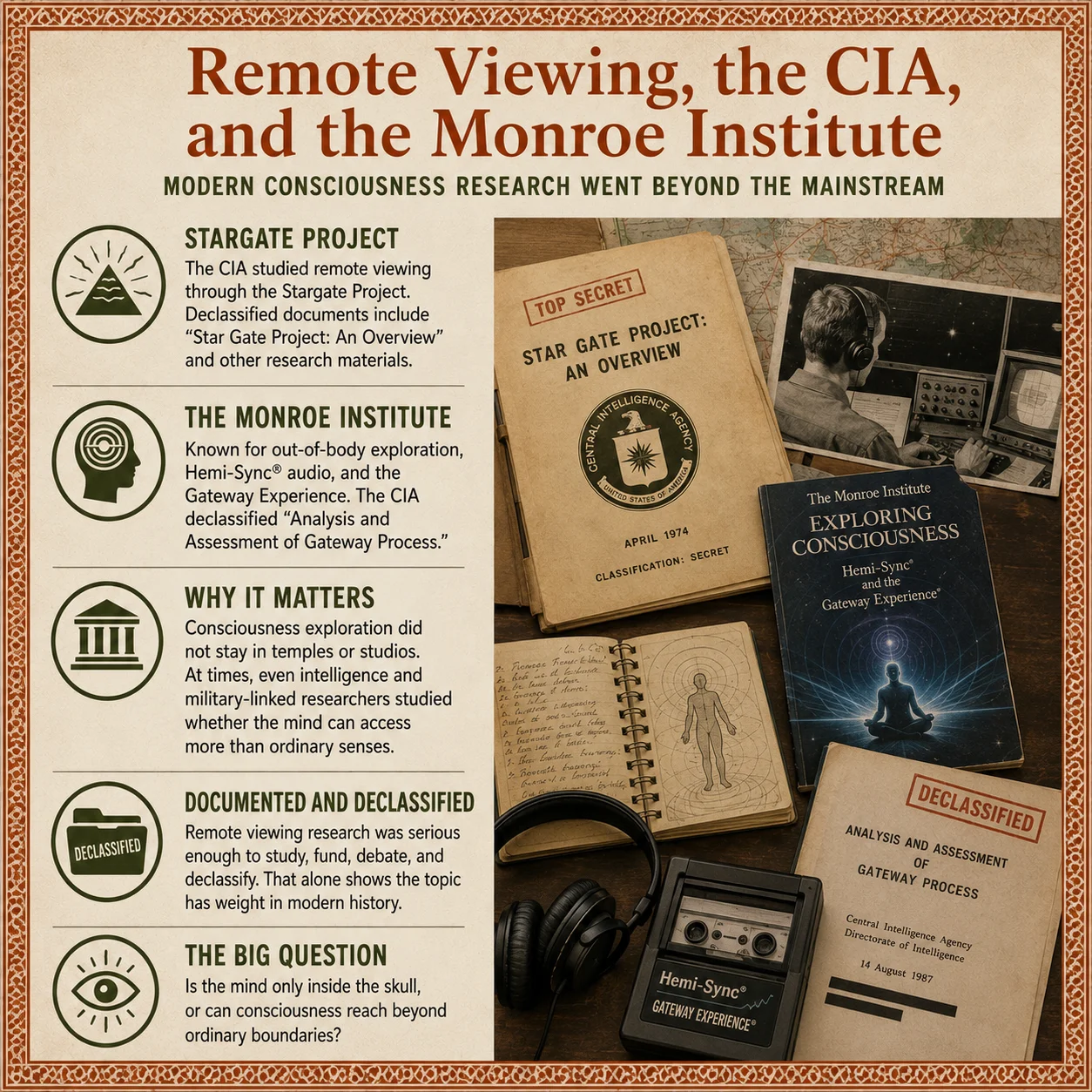
Remote Viewing, the CIA, and the Monroe Institute
Modern consciousness history gets even stranger when we reach remote viewing and government interest in altered states.
The U.S. government’s remote viewing research is most famously associated with the Stargate Project. CIA Reading Room documents include a “Star Gate Project: An Overview” and other declassified materials connected to remote viewing investigations.
The Monroe Institute also became part of modern consciousness culture through out-of-body exploration, Hemi-Sync audio technology, and the Gateway Experience. A declassified CIA document titled “Analysis and Assessment of Gateway Process” discusses the Monroe Institute’s Gateway system and altered consciousness framework.
All of this matters because it shows that consciousness can perceive things outside of the brain, just as the ancients said it could. Only now, governments are involved and proving it to be true.
Just like not all fortune tellers are real, this also doesn't mean that every remote viewing claim can be proven to be true. However, some are! Some claims can be verified. If you want a deep look into this, watch the movie:
Superhuman: The invisible made visible
Practice: Ancient Resonance
This practice is designed to help you feel connected to the long human story of meditation.
Sit with this music for a few minutes. Imagine yourself sitting beneath the night sky before books, phones, electricity, or modern science was ever invented. Imagine yourself looking at the stars and asking the same questions humans still ask today.
- Where did I come from?
- Why am I here?
- Can I be healed?
- Is there guidance?
- Can prayer reach something?
- Can my inner world change my outer life?
Now breathe slowly. When you inhale, breathe in through your nose and feel the air. Follow it all the way into your belly. When you blow the air out, just as slow, purse your lips as if you are blowing out a candle and follow the breath up through your throat and out of your mouth.
Place your attention on your forehead. It helps if you actuall look up as if you are trying to watch a picture screen on the inside of your skull. Tilt your eyes slightly upward but not the the point of being uncomfortable. If you feel your eyes flutter while doing this, it's perfectly normal.
Don't force anything and if a thought appears about your current life today simply allow that through to drift elsewhere. You can think about your current life when you are done. For now, you are going to become one with the ancients.
Sign in to access the platform
Play and Focus your mind.
Where the Sand Strips You Clean
4:37
0:00
4:37
When the music ends, write some thoughts about your experience:
Sign in to access the platform
What was your experience?
The ancient search for knowledge is alive in me because...
0/300